Before I add to a trade, I put a number on the worst case

Before I add to a trade, I work out how much room the thing has left to fall.
I put a specific number on the worst case. The number itself matters. The exercise of getting to it matters more.
Here's what that looks like in practice, on a position I'm running right now.
I'm long VIX into the autumn. The obvious risk is that vol simply keeps grinding lower through September and I bleed while I wait. So the question I have to answer honestly is how much lower can it realistically go from here.
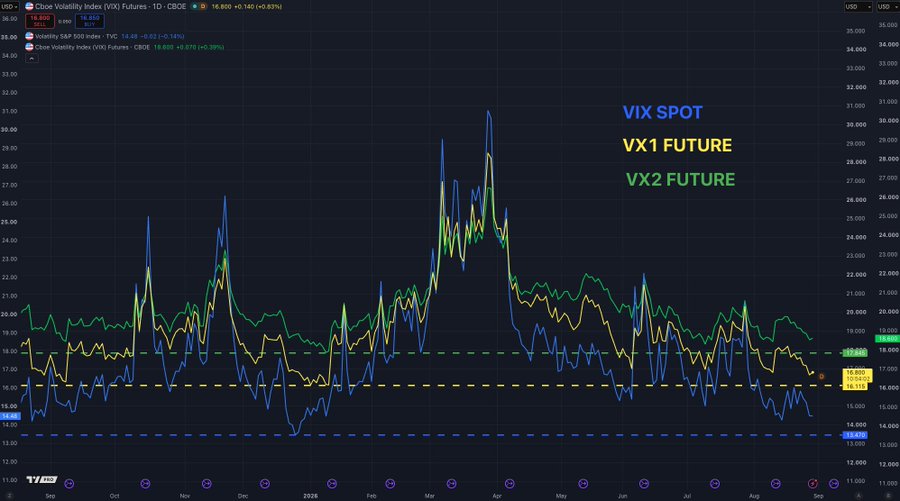
I pulled up a year of data on three things at once.
VIX spot. The front future. The second future. Then I marked the lows each of them reached, which was back in January.
Spot bottomed near 13.5. It sits around 14.5 now. So there's about a vol of downside to revisit that low.
The front contract bottomed near 16.10. It trades around 16.80 today. Call it roughly 70 basis points of downside.
The second contract bottomed near 17.85. Another 75 basis points to test that level.
Then the judgement bit.
October is the VIX contract that captures the midterms in its 30-day reference window. Is that specific contract really going to price zero event premium for a genuine political event? That makes very little sense to me.
So I put my realistic floor for October a bit higher than the January low. Somewhere around 17.50.
Now the number is useful.
I can look at any structure I'm considering and ask what it loses if the October contract sits at 17.50 in early October. Then I can design one where that level is roughly break-even. Downside covered. Upside intact. Any spike from a real event pays.
That's the whole game. The floor number turns a vague fear into a design constraint. The structure gets built around the constraint, and the hope stays out of the sizing conversation.
Knowing the worst case before you enter is what lets you add to something with a straight face.
Curious to know more about my daily processes? Free 60 minutes, linked below.
Watch my free masterclass (exclusive for serious option traders)
The bigger point about sizing and adds.
Most trade decisions get made in the direction the trader wants them to go. You want to be long, so you look for reasons to be long. You want to add, so you look at the setup for the reasons to add. The downside gets a passing glance.
The exercise of putting a number on the worst case forces you to look at the position from the side you'd rather not look at. That's what makes it useful. The number isn't precise, and the actual worst case won't land exactly there. The value is in the honest look.
Do the exercise for every add. Do it especially when you're feeling most confident about the position. That's the moment you're most likely to skip it, and the moment you most need to do it.
If you want to skip the masterclass and jump straight into our course, the Options Insight Advantage, this is the link.
Jump straight into our course, the Options Insight Advantage


Imran
Disclaimer (Your Gains & Losses, Your Responsibility): This content from Options Insight LLC (“Options Insight”) is for educational purposes only and does not provide individual investment advice or recommendations, nor should it be considered an offer to buy or sell any security. All information is general and not tailored to your specific objectives, financial situation, or risk tolerance. Employees of Options Insight may hold positions in the assets discussed. While we use sources believed to be reliable, we are not responsible for errors, omissions, or losses resulting from reliance on this content. Always consult a licensed investment professional.
Liked this? Imran writes one every market day. Get them direct to your inbox.