Portfolio Highlights: I made 100% on oil overnight. Then I did something most traders won't

Last week I put on an oil put ratio right before Trump's dramatic Iran deadline.
Short delta, short vol. 2-by-3 ratio.
The thesis was simple: Trump's MO is to talk big, then backtrack. The odds favoured a delay, some kind of TACO, and oil had been squeezing with vol pumped to the ceiling.
Next day? Oil dropped 15%. Vol collapsed 20 points.
The structure was up nearly 100% overnight.
Now here's where most traders get themselves in trouble.
They see 100% and think, "imagine if I hold for 200%." They start getting greedy. They forget that the reason they entered the trade has already played out.
I closed it.
Not because I'm conservative. Because the signals were shifting. Lebanon was still getting bombed. An actual Iran deal looked unlikely on the terms being floated. Oil could've ripped right back. (Over the weekend it did gap up 8% but has since faded)
So I banked the 3% on portfolio and moved on.
That one decision, taking money off the table when the thesis is done, not when greed is satisfied, is the difference between compounding and round-tripping.
The rest of the week told a different story.
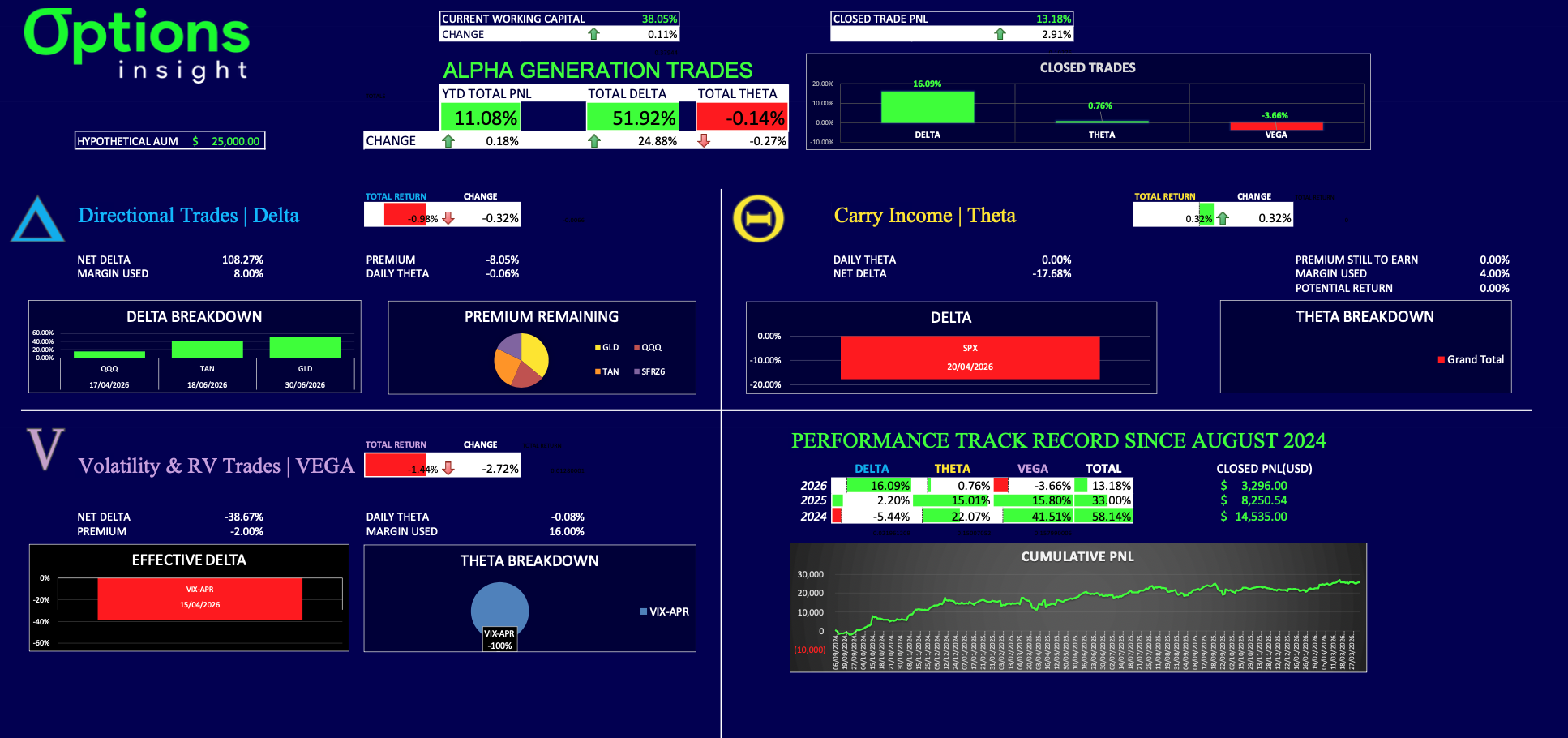
I had a VIX call fly that was working nicely when futures were at 26. Then the VIX got slammed back to 20 within a week. A sharper vol collapse than I anticipated.
But I kept it. Not out of hope. Because it was balancing the book and offsetting my longs in solar and gold. The net delta made sense even if the individual trade was underwater.
That's portfolio thinking instead of trade-by-trade P&L obsession.
Alpha Generation book? Flat on the week. The oil gain offset the VIX loss. Balanced book.
Meanwhile, Intel needed attention.
I bought Intel around $26 last year. It's above $60 now. Over 100% gain on the stock.
When something runs that hard, you don't just sit there hoping. You manage. Especially when it's rallied 50% in 2 weeks.
I put on a put spread collar, sold the 70 calls, bought the 55/45 put spread. If Intel keeps ripping through 70, I get called out of about three-quarters of my position. And I'm fine with that. Bought at 26, out at 70? That's not a problem.
If it corrects, I've got downside protection. And if it gets called away, I might start selling cash-covered puts in the mid-50s to get back in.
That's having an actual plan.
The bigger picture?
Long-only book was up 3.4% for the week. Everything contributed: equities, commodities, sterling bouncing from 1.3220 to 1.3450.
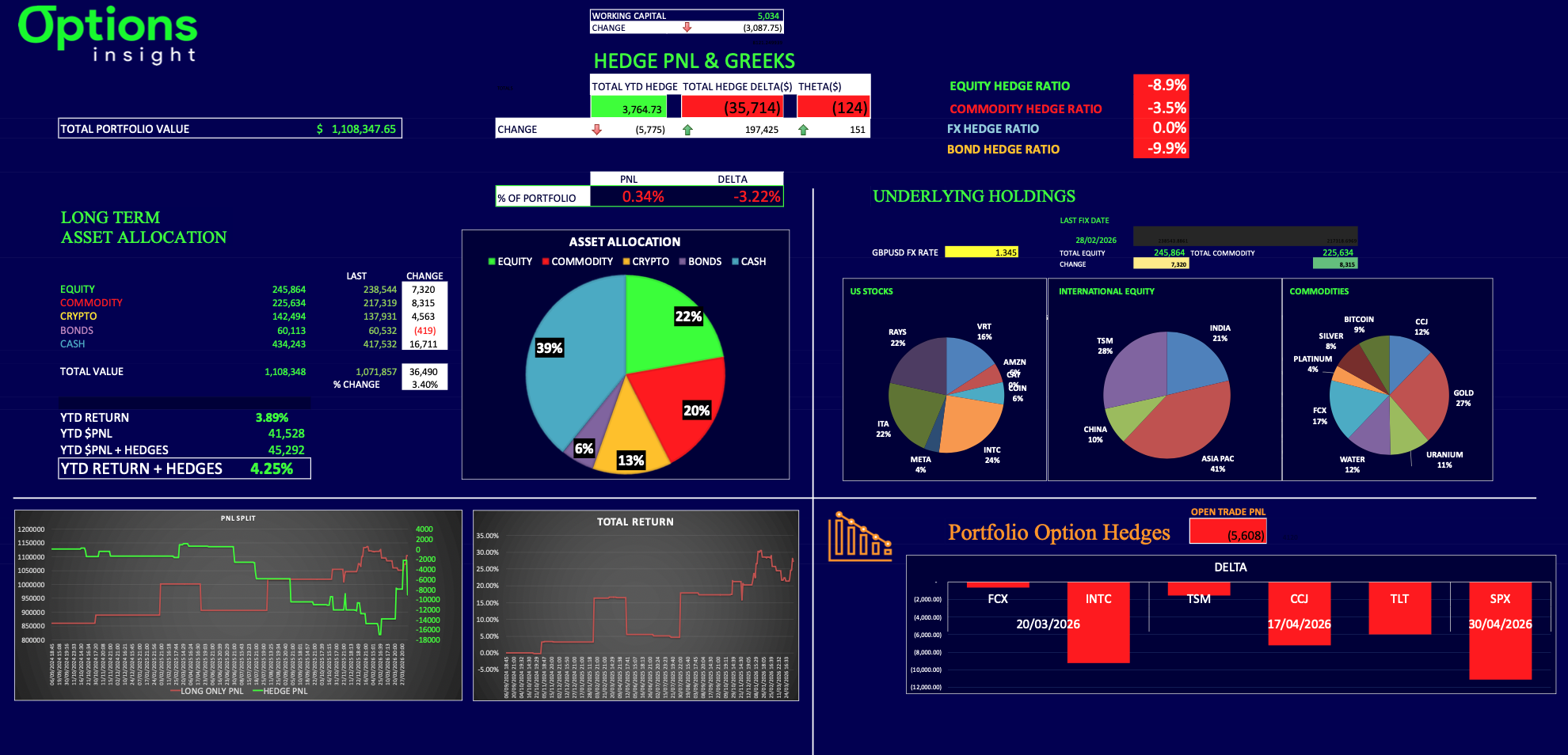
But my hedge ratios have decayed. Equity hedges down to 10%. Commodities next to nothing. That's the convexity at work; as the market rallies, option hedge deltas shrink. They've done their job.
On a 3.4% up-week, I only lost 0.58% in hedges. That's a 6:1 ratio. Perfect.
But from here? I need to get those hedges back to 30-40%. I'm not especially optimistic about the ceasefire playing out the way the market thinks. Cash is still healthy at 39%, which gives me room.
Every decision I just walked you through — the oil entry, the take-profit, the VIX position sizing, the Intel collar, the hedge rebalancing — comes from the same process.
Regime first.
Vol Metrics second
Trade Structure third
Risk Management always
That's not just instinct. It's a decision framework I've run for 20 years across institutional desks at Bank of America and Citibank. Through the GFC, COVID, and every regime shift in between.
And it's the same framework I teach inside The Ultimate Options Course.
I teach you a professional operating system that tells you which structure fits the regime, what the vol surface moves are telling us, and when to take the money off the table.
If you're reading this thinking "I would've held that oil trade too long" or "I never think about hedge ratios", well, that's the gap this course closes.
[See what's inside The Ultimate Options Course]
Talk soon,


Imran
Disclaimer (Your Gains & Losses, Your Responsibility): This content from Options Insight LLC (“Options Insight”) is for educational purposes only and does not provide individual investment advice or recommendations, nor should it be considered an offer to buy or sell any security. All information is general and not tailored to your specific objectives, financial situation, or risk tolerance. Employees of Options Insight may hold positions in the assets discussed. While we use sources believed to be reliable, we are not responsible for errors, omissions, or losses resulting from reliance on this content. Always consult a licensed investment professional.
Liked this? Imran writes one every market day. Get them direct to your inbox.