The VIX is a one-way street

Read this below with full attention...
The VIX is the most one-sided book in the entire market. Once you see it, a lot of the VIX's odd behaviour starts to make sense.
Here's the setup.
On the S&P, dealers are generally short puts and long calls. There's real two-way flow. In near-dated options that positioning can even flip depending on how flows land. It's a book with two sides.
On the VIX, dealers are almost always short the calls. Especially the 30-delta and higher upside strikes. That structural short-call position is permanent, and it shapes almost everything the VIX does.
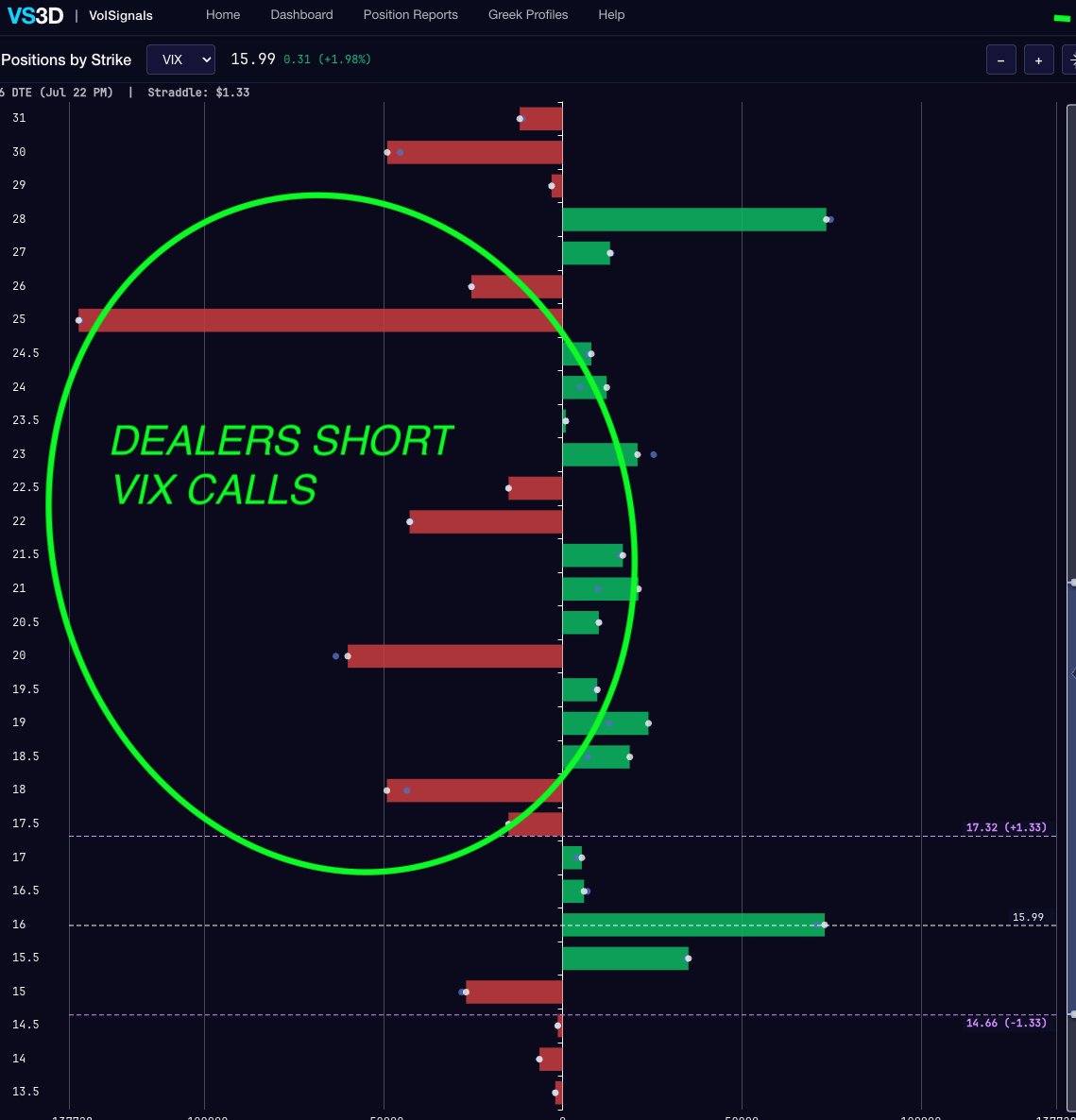
Everyone and their dog wants to own VIX calls as crash protection. Retail. Institutional. Hedge funds. Insurance flows. Everyone needs upside VIX exposure for the tail scenario. That demand runs through dealer desks in one direction only, and the dealers end up carrying the short-call position by default.
You basically never see dealers long VIX upside as a genuine directional bet. When they do own upside VIX, it's usually the higher leg of a call spread they got short lower down.
That's the setup. Permanent structural short calls on the upside.
Here's the mechanic that falls out of it.
As those upside calls decay into expiration, the delta on them collapses. The dealers who were holding VIX futures against the short calls now hold too many futures relative to the shrinking delta. They have to sell those futures down. Charm working in one direction, grinding the futures lower into every VIX expiration. That's in normal markets when VIX isn't moving up for some exogenous reason.
That's why the VIX tends to sag into its expiration. It's what's been happening up until yesterday, when more nasty war headlines dropped.
The sag is a mechanical consequence of a book that only has one side. Once you see the structural short-call position, the pattern becomes predictable.
For me, that's the thing to internalise about the VIX. It behaves like a one-way street built on a permanent short-call position. Which means every mechanic tied to that position, charm decay into expiry, dealer hedge unwinds, the persistent drift of the futures curve as it rolls down, all fall out of the same structural reality.
Reading the structural book behind an asset is how you go from watching VIX move to knowing why it moves.
If you'd like to go deeper into my frameworks I built across 20 years on bank options desks, check it out below.
The bigger point applies past the VIX.
Every asset has a structural dealer position that shapes its behaviour. Some are two-sided and dynamic like SPX. Some are one-sided and structural like VIX. Some sit in-between, like single-stock options where retail flow can shift the balance depending on the name.
If you can read which structural position dominates in a name, you can predict the mechanical patterns that fall out. Expiration behaviour, vol regime shifts, the way skew moves on flow. All of it starts with knowing which side of the book is permanent.
VIX sagging into expiry is the classic setup. It happens because the book only has one side. But remember, if VIX finds a reason to spike, it can also fuel a gamma squeeze higher if those calls suddenly go intrinsic.
If you want to skip the masterclass and jump straight into our course, the Options Insight Advantage, this is the link.


Imran
Disclaimer (Your Gains & Losses, Your Responsibility): This content from Options Insight LLC (“Options Insight”) is for educational purposes only and does not provide individual investment advice or recommendations, nor should it be considered an offer to buy or sell any security. All information is general and not tailored to your specific objectives, financial situation, or risk tolerance. Employees of Options Insight may hold positions in the assets discussed. While we use sources believed to be reliable, we are not responsible for errors, omissions, or losses resulting from reliance on this content. Always consult a licensed investment professional.
Liked this? Imran writes one every market day. Get them direct to your inbox.