Why I ignore GEX-by-strike numbers

The metric I actually use for reading dealer gamma at each strike is net position size in contracts. Position data is more stable, less spot-dependent, and easier to trade around than the dollar-GEX numbers most tools sell.
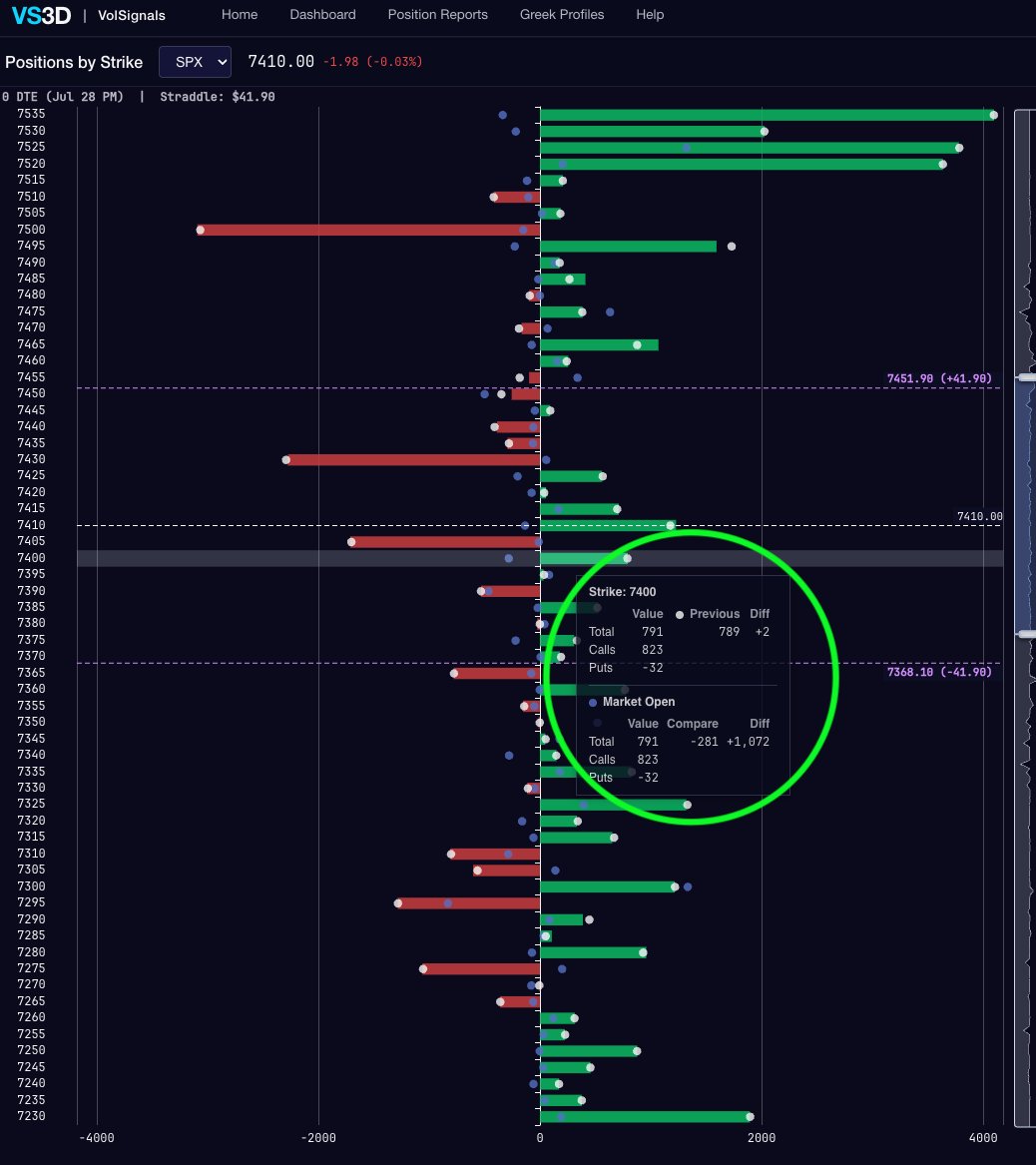
Here's why the GEX-by-strike number doesn't do the job.
Dollar gamma on a single strike is a moving target. It's a function of how close spot is to that strike. As spot moves toward the strike, the gamma number explodes. As spot drifts away, it collapses.
That means when you read a GEX-by-strike dashboard through the day, you're mostly watching a number react to price. What you're seeing is spot movement dressed up as positioning.
That lack of stability is hard to build a trade around. You can't tell whether the gamma at your target strike is changing because someone actually traded it, or because spot just wandered in the same direction.
Net position size in contracts fixes that.
The number only changes when someone genuinely trades the strike. Someone adds. Someone closes. Someone rolls. The count stays fixed the rest of the time, whatever spot does. That gives you a stable base to read from.
And I look at the net of calls and puts together at each strike, because once a market maker delta-hedges, a call and a put on the same strike are the same thing to them. It's all just gamma.
Practical example. A strike with 878 puts short and 282 calls long nets out to 596 short. That's the number that matters for gamma exposure at that strike. The net position tells you what dealers are actually managing. The two individual leg counts on their own tell you almost nothing about the hedging behaviour.
For the bigger question, is the street net long or short gamma overall, I only trust the total aggregate.
Per-strike GEX on just 0DTE can't answer that. It's a slice of one expiry, at one moment, with the spot-sensitivity distortion already baked in. The total aggregate across all strikes and all expiries is the number that tells you what the street is genuinely carrying.
Reading positioning data instead of noisy derived numbers is exactly the kind of institutional plumbing edge I care about and want others like you to exploit as well.
If interested to learn more, then the framework I built across 20 years on bank options desks can be found below.
The bigger lesson here.
Every retail-facing dashboard makes trade-offs to display data in a way that looks clean and quantitative. Some of those trade-offs matter. GEX-by-strike is a nice-looking number that reacts more to spot than to actual positioning changes. The metric feels institutional. The behaviour is unstable.
Position count in contracts is less flashy. There's no dollar sign in front of it. The number changes only when trading actually happens, which is exactly what you want a positioning metric to do.
Prefer the stable data over the noisy metric.
Lastly, if you want to skip the masterclass and jump straight into my course, the Options Insight Advantage, this is the link.


Imran
Disclaimer (Your Gains & Losses, Your Responsibility): This content from Options Insight LLC (“Options Insight”) is for educational purposes only and does not provide individual investment advice or recommendations, nor should it be considered an offer to buy or sell any security. All information is general and not tailored to your specific objectives, financial situation, or risk tolerance. Employees of Options Insight may hold positions in the assets discussed. While we use sources believed to be reliable, we are not responsible for errors, omissions, or losses resulting from reliance on this content. Always consult a licensed investment professional.
Liked this? Imran writes one every market day. Get them direct to your inbox.