Before you buy the call, look at the term structure

Before you buy that call, spend thirty seconds on the term structure.
There's a step between picking a direction and picking an expiry that's easy to skip. It's cost me money in the past when I've rushed it.
You've decided you're bullish. You've decided on a horizon. The obvious move is to go buy the call.
Before you place the order, look at the term structure. It's just implied vol plotted across expiries. The shape of that curve should influence which expiry you actually buy.
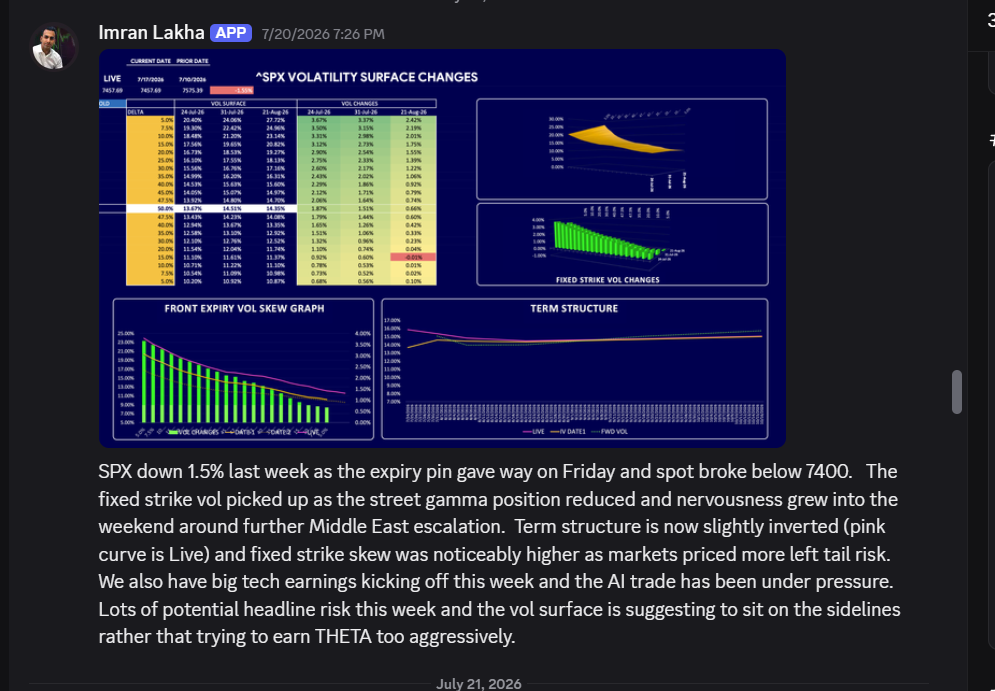
Say the curve is inverted right now. The front end is trading on a much higher vol than the back. That happens in stressed markets when everyone is buying short-dated protection or trading a specific event.
If you buy a short-dated call in that setup, you're buying the most expensive vol on the board. Vol mean reverts. Even if you get the direction exactly right, the vega bleed as the front end normalises back down can take a big chunk out of the P&L. You paid for a vol scenario the market has already priced in.
The reverse matters too.
If the curve is steeply upward-sloping, a long-dated option is being priced at a meaningfully higher vol than the front. That's the market saying it expects vol to rise over time. Buying that long-dated call means paying up for that expected vol expansion.
Might be right for your view. Might be wrong. Either way, you need to decide whether the extra time is worth the extra vol you're paying for it.
One clean way to handle it. Buy the long-dated option and spread it off to reduce the vega. You keep the direction, you shorten the vol exposure, and you stop overpaying for the back-end premium the curve was charging you.
The question expands. How long do I need? And which part of this curve am I actually comfortable owning, and for how long?
Reading term structure before you pick an expiry is exactly the kind of institutional check I do every day, and it separates paying full price for the wrong part of the curve from picking the expiry that actually fits your view.
If you want to know more insights, the framework I built across 20 years on bank options desks is below.
The bigger point.
Every expiry on the curve is a different vol trade. Same underlying. Same direction. Different implied vol, different rate of decay, different sensitivity to vol regime shifts.
Choosing an expiry is choosing which vol you want to own, on top of the direction you want to express. The trader who picks the expiry that fits both the direction and the curve is running a two-dimensional trade. The trader who picks the expiry that just fits the horizon is running a one-dimensional trade and paying for the second dimension by accident.
The vol curve is a menu. Every expiry has a different price on it. The expiry you pick decides which item you're actually ordering.
If you want to skip the masterclass and jump straight into our course, the Options Insight Advantage, this is the link.


Imran
Disclaimer (Your Gains & Losses, Your Responsibility): This content from Options Insight LLC (“Options Insight”) is for educational purposes only and does not provide individual investment advice or recommendations, nor should it be considered an offer to buy or sell any security. All information is general and not tailored to your specific objectives, financial situation, or risk tolerance. Employees of Options Insight may hold positions in the assets discussed. While we use sources believed to be reliable, we are not responsible for errors, omissions, or losses resulting from reliance on this content. Always consult a licensed investment professional.
Liked this? Imran writes one every market day. Get them direct to your inbox.